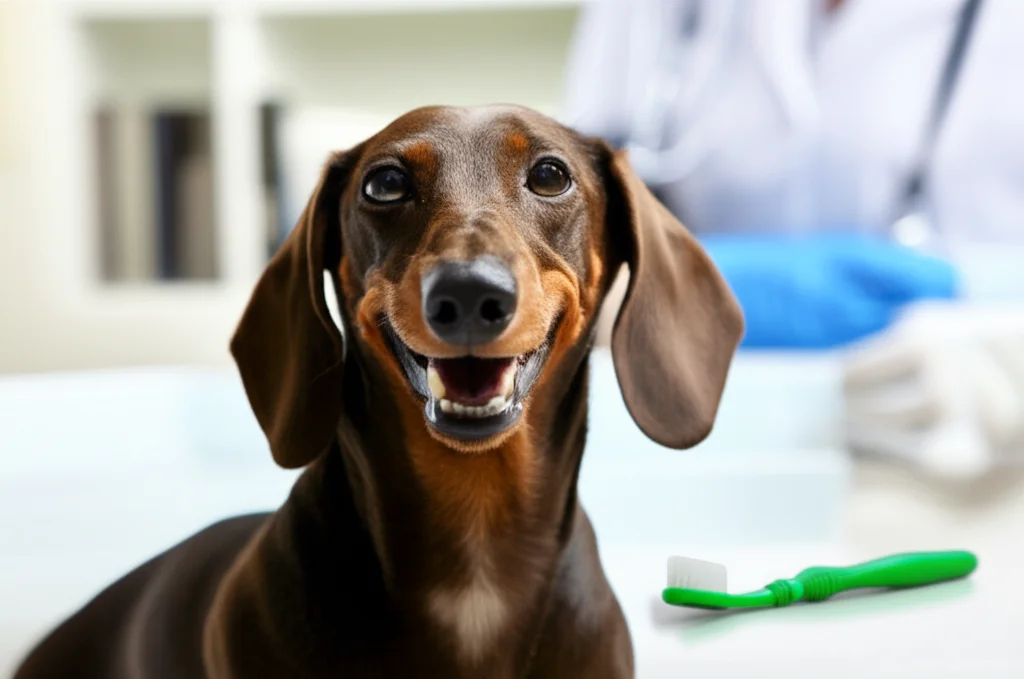
If your dachshund's breath has become noticeably unpleasant, it is probably more than just "dog breath." In the vast majority of cases, persistent bad breath in dogs signals some degree of periodontal disease. According to the American Veterinary Dental College (AVDC), approximately 80 percent of dogs show signs of oral disease by the age of three. For dachshunds and other small breeds, the odds are even worse. Research published in the Journal of Veterinary Dentistry in 2019 found that small-breed dogs are roughly 1.5 times more likely to develop periodontal disease than large-breed dogs.
Periodontal disease is not merely a cosmetic or comfort issue. When bacteria from infected gums enter the bloodstream, they can seed infections in distant organs, including the heart, kidneys, and liver. Multiple veterinary studies have confirmed this systemic connection, making dental health a matter of whole-body wellness. This guide covers everything a dachshund owner needs to know about dental care: why the breed is predisposed to oral problems, how to establish a brushing routine, which dental products actually work, and when professional intervention is necessary.
Why Dachshunds Are Prone to Dental Problems
Several anatomical and physiological factors combine to make dachshunds especially vulnerable to periodontal disease.
Crowded teeth in a small jaw. Every adult dog has 42 teeth, regardless of body size. A Great Dane and a miniature dachshund carry the same number of teeth, but the dachshund's jaw is a fraction of the size. This crowding means teeth sit close together, creating narrow gaps where food debris and plaque accumulate readily. Plaque mineralizes into tartar within 24 to 48 hours, and once tartar has formed in those tight crevices, no amount of home brushing can remove it.
Reduced saliva flow. Small dogs tend to produce less saliva relative to their oral surface area than larger dogs. Saliva plays a critical role in the mouth's natural self-cleaning mechanism by washing away food particles and buffering acids produced by bacteria. With less saliva, the dachshund's mouth is a more hospitable environment for the bacteria that drive periodontal disease.
Dietary habits. Dachshunds are famously food-motivated, which often means they receive more treats and soft foods than average. Soft and sticky foods cling to tooth surfaces and feed plaque-forming bacteria far more effectively than dry kibble does.
Retained deciduous teeth. Dachshunds are one of the breeds most prone to retained baby teeth, a condition in which deciduous teeth fail to fall out when the permanent teeth erupt. When both teeth occupy the same space, plaque and tartar accumulate rapidly in the gap between them, accelerating periodontal disease in the affected area. If you notice a double row of teeth in your dachshund puppy, consult your veterinarian about extraction.
Stages of Periodontal Disease and Warning Signs
Periodontal disease progresses through four recognized stages. Early detection is critical because the first stage is fully reversible, while later stages cause permanent damage.
Stage 1 — Gingivitis. The gums appear slightly reddened and may be mildly swollen, particularly along the gum line. There is no bone loss at this stage, and the condition is completely reversible with consistent home care. You might notice a subtle increase in breath odor.
Stage 2 — Early periodontitis. Gum inflammation becomes more pronounced, and bleeding may occur during brushing or chewing. Radiographs would reveal up to 25 percent loss of the bone that supports the teeth. Bad breath becomes clearly noticeable to the owner.
Stage 3 — Moderate periodontitis. Bone loss has reached 25 to 50 percent. Teeth may begin to loosen, and pus may be visible along the gum line. Dogs at this stage often show behavioral changes around mealtimes, such as dropping food, chewing on one side, or showing reluctance to eat hard kibble.
Stage 4 — Advanced periodontitis. More than 50 percent of the supporting bone has been destroyed. Teeth become loose or fall out entirely. The pain at this stage is significant, often leading to decreased appetite, weight loss, and reduced quality of life. Extraction of affected teeth is almost always necessary.
Warning signs that every owner should watch for include worsening breath odor, excessive drooling, visible tartar (a brown or yellow crust on the teeth), red or bleeding gums, pawing at the mouth, reluctance to eat hard food, and facial swelling. If you observe any of these signs, schedule a veterinary dental examination promptly.
How to Brush Your Dachshund's Teeth: A Step-by-Step Approach
Daily toothbrushing is the single most effective way to prevent periodontal disease. However, most dogs do not naturally accept having a toothbrush placed in their mouth. Success depends on a gradual desensitization process that builds positive associations at every step. Rushing leads to resistance, and resistance makes long-term compliance nearly impossible.
Step 1: Familiarize your dog with mouth handling (1 to 2 weeks)
Begin by gently touching your dachshund's muzzle, lips, and chin during calm, relaxed moments. Reward each successful touch with praise and a small treat. Once your dog is comfortable with external touching, start lifting the lips to expose the teeth and gums. Do this for just a few seconds at first, gradually increasing the duration over the course of one to two weeks.
Step 2: Introduce the toothpaste flavor (1 to 2 weeks)
Place a small amount of dog-specific enzymatic toothpaste on your fingertip and let your dog lick it off. Most enzymatic toothpastes come in flavors like poultry, beef, or seafood that dogs find appealing. Once your dog eagerly licks the paste, gently rub it along the front teeth and canines with your finger. Keep each session under 30 seconds and always end with a reward.
Step 3: Transition to gauze or a finger brush (1 to 2 weeks)
Wrap a small piece of damp gauze around your finger, apply toothpaste, and gently wipe the outer surfaces of the teeth using a circular motion. Focus on the gum line, where plaque accumulates most aggressively. A silicone finger brush is an excellent alternative at this stage, giving slightly more scrubbing action than gauze alone.
Step 4: Introduce the toothbrush
Select a toothbrush designed for small or toy breeds. The head should be small enough to reach your dachshund's back molars comfortably. Apply enzymatic toothpaste to the brush and hold it at a 45-degree angle to the gum line. Use gentle circular or back-and-forth motions, starting with the canines and front teeth before moving to the premolars and molars. The outer surfaces (the cheek side) of the teeth are the most important, as this is where tartar tends to build up fastest.
Critical safety note: Never use human toothpaste on your dog. Many human formulations contain xylitol, an artificial sweetener that is highly toxic to dogs, as well as fluoride and foaming agents that are not safe for ingestion. Always use a toothpaste specifically formulated for dogs, which is designed to be swallowed safely and does not require rinsing.

Virbac C.E.T. Enzymatic Toothpaste for Dogs, Poultry Flavor
Veterinarian-recommended enzymatic toothpaste featuring the C.E.T. Dual Enzyme System to inhibit plaque formation. The poultry flavor is highly palatable, making it easier to establish a brushing routine. No rinsing required — safe for dogs to swallow.
How Often Should You Brush and When
The gold standard is once per day. Plaque begins forming within six to eight hours after a meal and hardens into tartar within 24 to 48 hours. Daily brushing interrupts this cycle before mineralization occurs.
If daily brushing is genuinely not feasible for your schedule, aim for a minimum of three times per week. Veterinary dental research has shown that brushing at least every other day can significantly slow the progression of periodontal disease, though daily brushing remains clearly superior.
The best time to brush is in the evening, when your dachshund has settled down after the day's walks and activities. A slightly tired dog is more cooperative. Post-walk relaxation time is ideal. Consistency matters more than perfection — brushing at the same time each day helps make it a predictable part of the routine that your dog comes to accept.
Each brushing session should take approximately two to three minutes. Attempting to scrub every surface meticulously for ten minutes will only create a negative association. A brief, efficient session done every day is far more effective than an occasional marathon session.
Dental Chews and Toys: Helpful Supplements, Not Replacements
Dental chews and toys serve a valuable supplementary role in oral care, but they cannot replace toothbrushing. Think of them as you would think of sugar-free gum for humans — a useful addition, but not a substitute for brushing.
Choosing effective dental chews
Look for the VOHC Seal of Acceptance. The Veterinary Oral Health Council (VOHC) independently evaluates dental products for dogs and awards its seal only to those that demonstrate measurable plaque or tartar reduction in controlled trials. A VOHC-accepted chew has proven efficacy.
Select the right size. For most dachshunds, a "teenie" or "petite" size dental chew is appropriate. A chew that is too large places unnecessary strain on the jaw, while one that is too small presents a choking hazard.
Avoid excessively hard chews. Antlers, hooves, and real bones are frequently marketed as dental aids, but they are hard enough to fracture teeth. The general rule of thumb is that if you cannot make a dent in the chew with your thumbnail, it is too hard for your dog's teeth.
Check the ingredients. Choose chews made from digestible ingredients with minimal artificial additives. High-quality dental chews are typically formulated to break down safely in the digestive tract if swallowed in larger-than-intended pieces.

Greenies Original Dental Dog Treats, Teenie Size
VOHC-accepted dental treats with a unique chewy texture that cleans down to the gum line. Teenie size is designed for dogs 5 to 15 pounds, making them well-suited for miniature dachshunds. Formulated as a complete and balanced treat with added vitamins, minerals, and nutrients.
Dental toys
Rubber chew toys with textured surfaces can help scrub plaque from teeth during play. Rope toys may also provide some cleaning action, though frayed ropes should be discarded to prevent ingestion of fibers. Dental toys work best when combined with regular brushing, not as a standalone strategy.
Professional Dental Cleaning (Scaling and Polishing)
Even with diligent home care, most dogs will eventually need professional dental cleaning at a veterinary clinic. The frequency depends on the individual dog's oral health, but annual dental examinations are recommended for all dachshunds, with professional cleaning performed as needed.
What the procedure involves
A professional dental cleaning, performed under general anesthesia, includes a thorough oral examination, full-mouth dental radiographs (X-rays), ultrasonic scaling to remove tartar above and below the gum line, hand scaling of stubborn deposits, and polishing to smooth the tooth surfaces and slow future plaque accumulation. If periodontal disease is detected, the veterinarian may perform extractions, root planing, or other periodontal treatments.
Why general anesthesia is necessary
Dogs cannot be asked to open wide, hold still, and tolerate discomfort the way human dental patients can. General anesthesia allows the veterinarian to perform a complete examination and treatment without causing pain or stress to the animal, and without the risk of the dog biting or moving suddenly during a procedure involving sharp instruments. Both the American Veterinary Dental College and the European Veterinary Dental College strongly advise against "anesthesia-free" dental cleanings. These non-anesthetic procedures can only address visible tartar on the tooth crown; they cannot reach below the gum line, where the most destructive disease process occurs.
Cost and frequency
The cost of a professional dental cleaning varies by region and the extent of treatment needed. In the United States, expect to pay between $300 and $800 for a routine cleaning, including pre-anesthetic bloodwork. Extractions and advanced periodontal treatments add to the total. Maintaining a consistent home care routine can reduce the frequency and cost of professional cleanings over your dog's lifetime.
Feeding for Dental Health
Daily nutrition choices have a meaningful impact on dental health. While no food can replace brushing, certain dietary strategies support a cleaner mouth.
Favor dry kibble over wet food. The mechanical action of chewing kibble provides a mild abrasive effect on tooth surfaces. Wet food, by contrast, tends to adhere to teeth and promote plaque formation. If your dachshund eats wet food, be especially diligent about post-meal dental care.
Consider dental-specific diets. Some veterinary diet manufacturers produce kibble with oversized pieces and a fiber matrix engineered to scrub the tooth surface as the dog chews. Certain dental diets carry the VOHC seal, meaning they have been independently proven to reduce plaque or tartar accumulation.
Limit sticky treats. Soft jerky treats, peanut butter, and table scraps are among the worst offenders for sticking to teeth and feeding oral bacteria. When you do give treats, dental chews are a smarter choice.
Ensure adequate hydration. Water stimulates saliva production, and saliva is the mouth's first line of defense against bacterial buildup. Keep fresh water available at all times.
Frequently Asked Questions
Should I start brushing my dachshund puppy's teeth?
Absolutely. Beginning oral care during puppyhood is one of the best investments you can make in your dog's long-term dental health. Although your puppy's deciduous teeth will be replaced by permanent teeth at four to six months of age, the goal at this stage is to build tolerance for mouth handling and brushing. A puppy that learns to accept toothbrushing as a normal part of the daily routine will be far easier to manage as an adult. Additionally, early and regular mouth inspections help you catch problems like retained deciduous teeth, which are relatively common in dachshunds and require prompt veterinary attention.
My dachshund absolutely refuses to let me brush. What should I do?
Start further back in the desensitization process. Let your dog lick enzymatic toothpaste off your finger as a treat for several days, associating the taste with something positive. Then progress to brief, gentle touches on the lips and teeth, rewarding each moment of tolerance. Keep sessions extremely short, even as brief as five to ten seconds, and never force the issue. If your dog pulls away, let them go and try again later. Over time, most dogs will gradually accept more handling. In the meantime, enzymatic dental gels that can be applied to the gum line without brushing, VOHC-accepted dental chews, and water additives can provide some level of oral care. Consult your veterinarian or a certified animal behaviorist if resistance persists despite patient, gradual training.
Can dental chews alone prevent periodontal disease?
Dental chews can reduce plaque and tartar accumulation, but they cannot prevent periodontal disease on their own. Chewing primarily cleans the biting surfaces and some of the outer tooth surfaces, but it does little to address plaque along the gum line or between teeth, which are the areas where periodontal disease initiates. Think of dental chews as a valuable supplement to brushing, not a substitute. The most effective prevention strategy combines daily brushing, regular use of VOHC-accepted dental chews, a dental-supportive diet, and periodic professional cleanings.
My dog has terrible breath. Should I see a vet immediately?
Persistent, strong mouth odor is a red flag that should not be ignored. A foul or rotting smell often indicates advanced periodontal infection in which bacteria are actively destroying gum tissue and bone. However, unusually sweet or fruity breath can indicate diabetes, while an ammonia-like smell may point to kidney disease. In all cases, a veterinary examination is warranted to identify the underlying cause. The sooner periodontal disease is diagnosed and treated, the more teeth can be saved and the better the outcome for your dog's overall health.
Summary
Dachshunds face an elevated risk of periodontal disease due to their small jaws, crowded teeth, and reduced saliva flow. The consequences of untreated dental disease extend far beyond the mouth, potentially affecting the heart, kidneys, and liver.
The cornerstone of prevention is daily toothbrushing with a dog-specific enzymatic toothpaste. Building a brushing routine takes patience and consistency, but the long-term payoff in dental health and reduced veterinary costs is substantial. Supplement brushing with VOHC-accepted dental chews, choose a diet that supports oral health, and schedule annual dental examinations with your veterinarian.
Dental care is not optional — it is one of the most important aspects of responsible dachshund ownership. Starting today, even with something as simple as letting your dog taste enzymatic toothpaste, puts you on the path toward a lifetime of healthier teeth and a happier dog.