Dachshunds consistently rank among the most difficult breeds to train, not because they lack intelligence but because they possess it in abundance paired with a fiercely independent temperament. These are dogs that were bred to enter underground badger dens alone, make life-or-death decisions without human guidance, and fight prey much larger than themselves. That heritage gave them extraordinary courage, determination, and problem-solving ability. It also gave them a deeply ingrained tendency to do things their own way.
Understanding this context is essential before you begin training your dachshund. The techniques that work beautifully with eager-to-please breeds like golden retrievers or border collies may fall flat with a dachshund that is busy calculating whether your request is worth its time. The good news is that dachshunds are highly food-motivated and deeply bonded to their owners, which gives you powerful leverage when you use the right approach. This guide breaks down the science-based principles of effective dachshund training and provides step-by-step instructions for the skills every dachshund owner needs.
Understanding the Dachshund Temperament
Before you can train a dachshund effectively, you need to understand what drives their behavior. Dachshund temperament is shaped by centuries of selective breeding for specific working traits.
The Hunting Heritage
Dachshunds were developed in Germany as scenthound specialists. The word "dachshund" literally translates to "badger dog." Their elongated bodies and short, powerful legs allowed them to enter and navigate narrow underground tunnels. Once underground, they were on their own. No handler could direct them. They had to independently track the quarry by scent, corner or flush the animal, and bark to alert the hunter above ground to their location. This work demanded intelligence, persistence, boldness, and a strong independent streak.
These traits remain deeply embedded in the modern dachshund's personality:
Independence: A dachshund does not instinctively look to you for direction the way a herding breed does. They are genetically programmed to think for themselves. In a training context, this manifests as selective hearing, choosing when to comply, and testing boundaries.
Determination (stubbornness): The quality that kept a dachshund working in a dark tunnel for hours is the same quality that keeps your dachshund fixated on the scent trail in your backyard when you are calling them to come inside. Dachshunds do not give up easily, whether they are pursuing a goal you approve of or one you do not.
Boldness and confidence: Dachshunds have an outsized personality relative to their physical size. They are often fearless to the point of being reckless. This boldness means they are less likely to be intimidated by correction-based training but also less likely to defer to you simply because you are bigger.
High prey drive and scent orientation: Dachshunds are scent hounds with an exceptionally keen nose. When their nose catches something interesting, their brain shifts into hunting mode, and your voice becomes background noise.
Vocal tendency: Underground hunters needed to bark loudly and persistently to signal their location to the hunter above. Modern dachshunds carry this vocal tendency into domestic life, reacting to doorbells, strangers, other dogs, passing cars, and sometimes nothing identifiable at all.
What This Means for Training
The dachshund temperament is not a flaw to be corrected. It is a feature to be understood and channeled. Harsh training methods are particularly counterproductive with this breed. Dachshunds are emotionally sensitive beneath their bold exterior, and punitive approaches damage the trust relationship, increase anxiety, and frequently intensify the very behaviors you are trying to eliminate. Positive reinforcement, patience, and strategic thinking are your most effective tools.
The Science of Positive Reinforcement Training
Positive reinforcement training is grounded in operant conditioning, a principle of behavioral psychology established through decades of scientific research. The core idea is straightforward: behaviors that are followed by rewarding consequences are more likely to be repeated. When your dachshund sits on cue and receives a treat, the association between the action and the reward strengthens, making the dog more likely to sit the next time they hear the cue.
Choosing Effective Rewards
Food: This is your primary training tool with a dachshund. The breed's food drive is legendary, and treats create the clearest, most immediate reinforcement connection. Use small (pea-sized), soft treats that can be consumed in under two seconds. The goal is quick reinforcement, not a meal break. Keep a variety of treat values available. Save the highest-value treats (cheese, freeze-dried liver, deli meat) for the most challenging exercises and environments.
Verbal praise: A cheerful "yes!" or "good dog!" delivered with genuine enthusiasm. Pair verbal praise with treats during initial training so the words themselves become rewarding through classical conditioning.
Play and affection: Some dachshunds find a brief tug game or belly rub as motivating as food. Discover what your individual dog values most.
Timing Is Everything
The reward must arrive within one to two seconds of the desired behavior. If your dachshund sits and you spend five seconds rummaging through your pocket for a treat, the dog cannot clearly connect the reward to the action. This is where a clicker or a verbal marker becomes invaluable.
The Power of Clicker Training
A clicker is a small device that produces a distinct "click" sound. Through initial conditioning (click, then immediately treat, repeated 20 to 30 times), the dog learns that the click sound means a reward is coming. The clicker then functions as a precise marker: you click at the exact instant the dog performs the correct behavior, and the treat follows within a few seconds.
The advantage of a clicker is precision. You can mark a behavior with sub-second accuracy, which is far more precise than fumbling for a treat or even delivering a verbal "yes." This precision dramatically accelerates learning, which is particularly valuable when training an independent thinker like a dachshund who needs crystal-clear communication to stay engaged.

Karen Pryor i-Click Dog Training Clicker (3-Pack)
Developed by pioneering animal behaviorist Karen Pryor, the i-Click produces a softer, more ergonomic click than traditional box clickers. The quiet sound is ideal for noise-sensitive dachshunds. Includes three clickers so you can keep one in multiple locations.
Teaching Essential Commands
Sit
"Sit" is the foundation command that serves as a gateway to all other obedience skills.
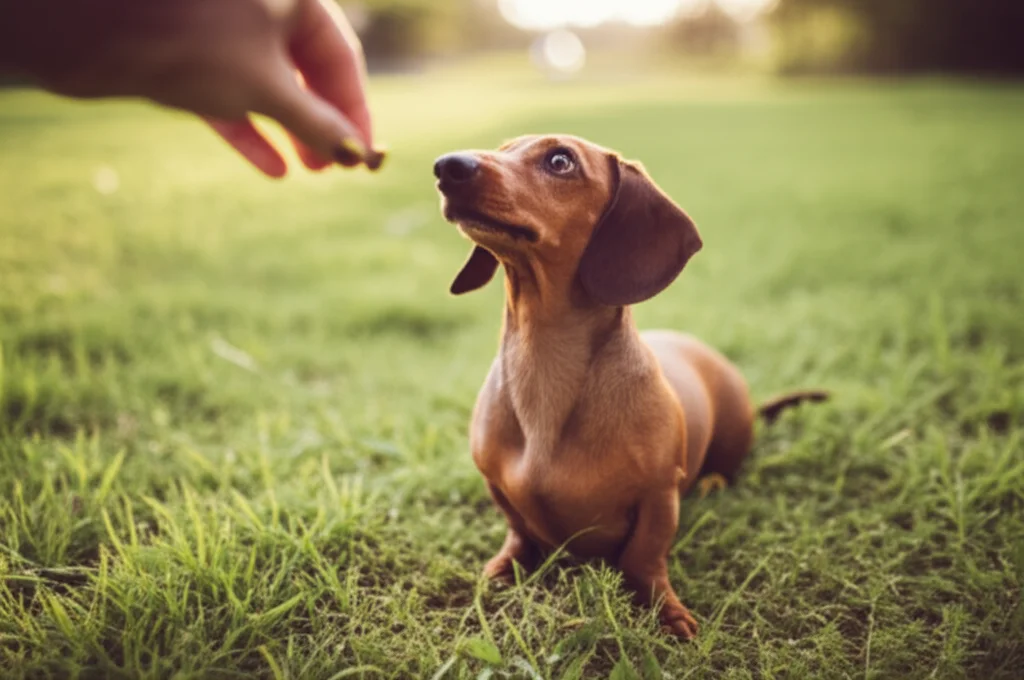
Step 1: Hold a small treat between your thumb and forefinger, close to your dog's nose. Let them sniff it but not take it.
Step 2: Slowly move the treat upward and slightly backward over the dog's head. As the dog's nose follows the treat upward, their rear end naturally lowers toward the ground.
Step 3: The moment the rear touches the floor, click (or say "yes!") and deliver the treat immediately.
Step 4: After several successful repetitions, add the verbal cue "sit" just before you begin the hand motion. The dog will start to associate the word with the action.
Step 5: Gradually reduce the lure. Make the hand motion without a treat in your hand, then click and deliver a treat from your pocket or pouch. Over time, make the hand motion smaller until it becomes a subtle hand signal.
Dachshund note: Because of their long body, dachshunds sometimes try to back up rather than sit when a treat is moved over their head. Practice against a wall or in a corner so the dog has no room to reverse and naturally defaults to sitting.
Stay
"Stay" teaches impulse control, which is particularly important for a breed that tends to act on its own initiative.
Step 1: Ask your dog to sit. With the dog in a sit, hold your palm facing the dog and say "stay."
Step 2: Wait one second, then click and treat while the dog is still in position. If the dog breaks the stay before one second, simply reset and try again. Do not scold.
Step 3: Gradually increase the duration: two seconds, three seconds, five seconds, ten seconds, thirty seconds. Increase in small increments and return to an easier level if the dog fails twice in a row.
Step 4: Once the dog can hold a stay for 30 seconds, begin adding distance. Take one small step back, then immediately return and reward. Gradually increase the number of steps.
Step 5: Add distractions only after the dog is solid on both duration and distance separately. Combine all three elements (duration, distance, distraction) very gradually.
Important: Always release your dog from the stay with a specific release word like "okay" or "free." The dog should learn that staying in position continues until you say otherwise.
Come (Recall)
A reliable recall can save your dachshund's life. It is also one of the hardest commands to master with this breed because it requires the dog to abandon whatever they are doing (often sniffing something fascinating) and return to you.
Step 1: Start in a quiet indoor environment with zero distractions. Say your dog's name followed by "come" in an excited, inviting tone.
Step 2: When the dog approaches you, click and deliver an exceptionally high-value reward. Make coming to you the best thing that happens all day.
Step 3: Practice at increasing distances indoors, then in a fenced yard, then on a long leash (15 to 30 feet) in progressively more distracting environments.
Critical rule: Never, under any circumstances, call your dog to you and then do something they dislike (bath, nail trim, crate for departure). If you need to do something unpleasant, go get the dog instead of calling them. Every single recall must end positively, or the command will deteriorate.
Dachshund-specific challenge: When a dachshund locks onto a scent, they enter a state of focused intensity that is difficult to interrupt with voice alone. For this reason, many dachshund trainers recommend never allowing off-leash freedom in unfenced areas, regardless of how reliable the recall seems in training. The breed's hunting instinct can override training in a split second when the right scent appears.
Addressing Excessive Barking
Barking is the number one behavior complaint among dachshund owners, and for good reason. Research published in Scientific Reports (2019) identified dachshunds among the breeds with the highest frequency of excessive barking. The behavior is deeply rooted in the breed's function as an earth dog that needed to bark underground to communicate with the hunter above.
Identifying the Trigger
Effective bark management begins with understanding why your dachshund is barking.
Alert barking: Triggered by sounds (doorbell, knocking, outdoor noises) or sights (people or animals passing windows). The dog is announcing a perceived intrusion.
Demand barking: The dog barks at you because it wants something: food, attention, play, access to furniture, or to go outside. This type of barking is often inadvertently reinforced when owners give in.
Excitement barking: Occurs during high-arousal moments such as greeting people, preparing for walks, or seeing other dogs. The barking accompanies generalized excitement.
Anxiety barking: Persistent, often high-pitched barking that occurs during separation from the owner. This may be accompanied by destructive behavior, pacing, and house soiling.
Training Strategies for Each Type
For alert barking: Teach an incompatible behavior. Train your dachshund to go to a specific mat or bed when the doorbell rings. Begin by training the "go to your place" command independently, using treats to lure the dog to the mat and rewarding heavily for staying there. Once reliable, introduce the doorbell as the cue. The dog learns that the doorbell means "go to your mat and get treats" rather than "bark wildly at the door."
You can also teach a "quiet" command: allow two to three barks (some alert barking is natural and acceptable), then hold a treat to the dog's nose. The dog will stop barking to sniff the treat. Say "quiet," pause one second, then deliver the treat. Gradually increase the quiet duration before treating.
For demand barking: This requires an extinction protocol. When the dog barks for attention or demands, respond with complete non-reaction. No eye contact, no speaking, no touching. The moment the dog is silent (even for two seconds), immediately reward. Be prepared for an extinction burst: the barking will temporarily intensify before it decreases as the dog tests whether more volume or persistence will work. Consistency from every household member is essential. One person caving and responding to barking will undo the training.
For excitement barking: Teach calm behaviors in low-arousal contexts first, then gradually introduce exciting stimuli. For example, if your dachshund barks when the leash comes out, pick up the leash and stand still. Wait for silence. Mark and reward silence. Put the leash down. Repeat. Only proceed toward the door when the dog is quiet. Only open the door when the dog is quiet. The dog learns that calm behavior makes the walk happen faster.
For anxiety barking: Separation anxiety is a clinical condition, not a training problem in the traditional sense. It requires a systematic desensitization program (gradually increasing alone time from seconds to minutes to hours), and in some cases, veterinary intervention including anti-anxiety medication. Consult a veterinary behaviorist or a certified applied animal behaviorist if you suspect separation anxiety.
Correcting Nipping and Mouthing
Puppy Mouthing
All puppies explore the world with their mouths, and dachshund puppies are no exception. During the teething period (3 to 6 months), the urge to chew intensifies as new teeth push through the gums. The goal is not to eliminate mouthing entirely (that is developmentally inappropriate) but to teach bite inhibition and redirect mouthing to appropriate items.
When teeth touch skin: Say "ouch" in a neutral but firm tone, immediately withdraw your hand, and turn away from the puppy for 10 to 15 seconds. Resume interaction. If teeth touch skin again, repeat. If it happens a third time, leave the area entirely for 30 seconds. The puppy learns that biting ends all fun.
Provide alternatives: Have a variety of chew toys readily accessible. Rubber toys that can be frozen (like Kong-style toys stuffed with peanut butter or wet food and frozen) are particularly effective during teething because the cold soothes sore gums.
Consistency: Every person who interacts with the puppy must follow the same protocol. If children or visitors allow the puppy to mouth their hands, it undermines the training.
Adult Mouthing or Biting
If an adult dachshund mouths or bites, the situation requires careful assessment. Possible causes include pain (dental issues, injury), fear, resource guarding, or frustration. Consult your veterinarian to rule out medical causes, then work with a qualified professional trainer or behaviorist if the behavior persists.
Potty Training: The Dachshund Challenge
Dachshunds appear on virtually every list of breeds that are difficult to house-train. While individual dogs vary widely, the breed's independent nature and their dislike of unpleasant weather (many dachshunds will refuse to eliminate outside in rain or cold) contribute to the reputation.
Keys to Success
Confinement and supervision: When you cannot directly supervise your dachshund, they should be in a crate or a small, puppy-proofed area. Giving an un-house-trained dachshund free roam of the house is setting them up to fail.
Frequent outings: Take your dachshund to the designated potty area immediately after waking, after eating, after playing, and after napping. For puppies, add an outing every 30 to 60 minutes during waking hours.
Reward success enthusiastically: When your dachshund eliminates in the correct spot, treat it like a major celebration. High-value treat, verbal praise, excited tone. The reward must happen within two seconds of the behavior completing.
Clean accidents thoroughly: Use an enzymatic cleaner specifically designed for pet odors. Standard household cleaners do not fully eliminate the scent molecules that a dog's nose can detect, and lingering odor encourages the dog to use the same spot again.
Never punish accidents: Rubbing a dog's nose in a mess, swatting them with a newspaper, or yelling after the fact does not teach the dog where to eliminate. It teaches them that you are unpredictable and dangerous around urine and feces, which causes the dog to hide their eliminations, making the problem worse.
Weather considerations: If your dachshund refuses to go outside in rain or cold, create a covered outdoor area, use an umbrella to shelter them, or consider maintaining an indoor potty option (such as a designated pad area) as a backup for inclement weather.
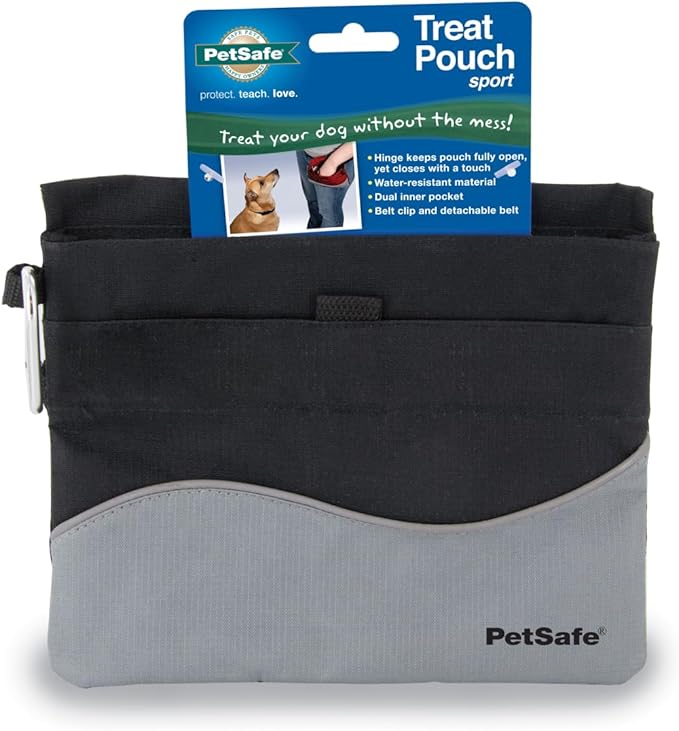
PetSafe Treat Pouch Sport
Hinged treat pouch stays open for easy access during training sessions. Features a waterproof interior, belt clip and waistband loop, and a front zippered pocket for keys, phone, or clicker. Essential gear for reward-based dachshund training on walks and at home.
Leash Manners: Ending the Pulling
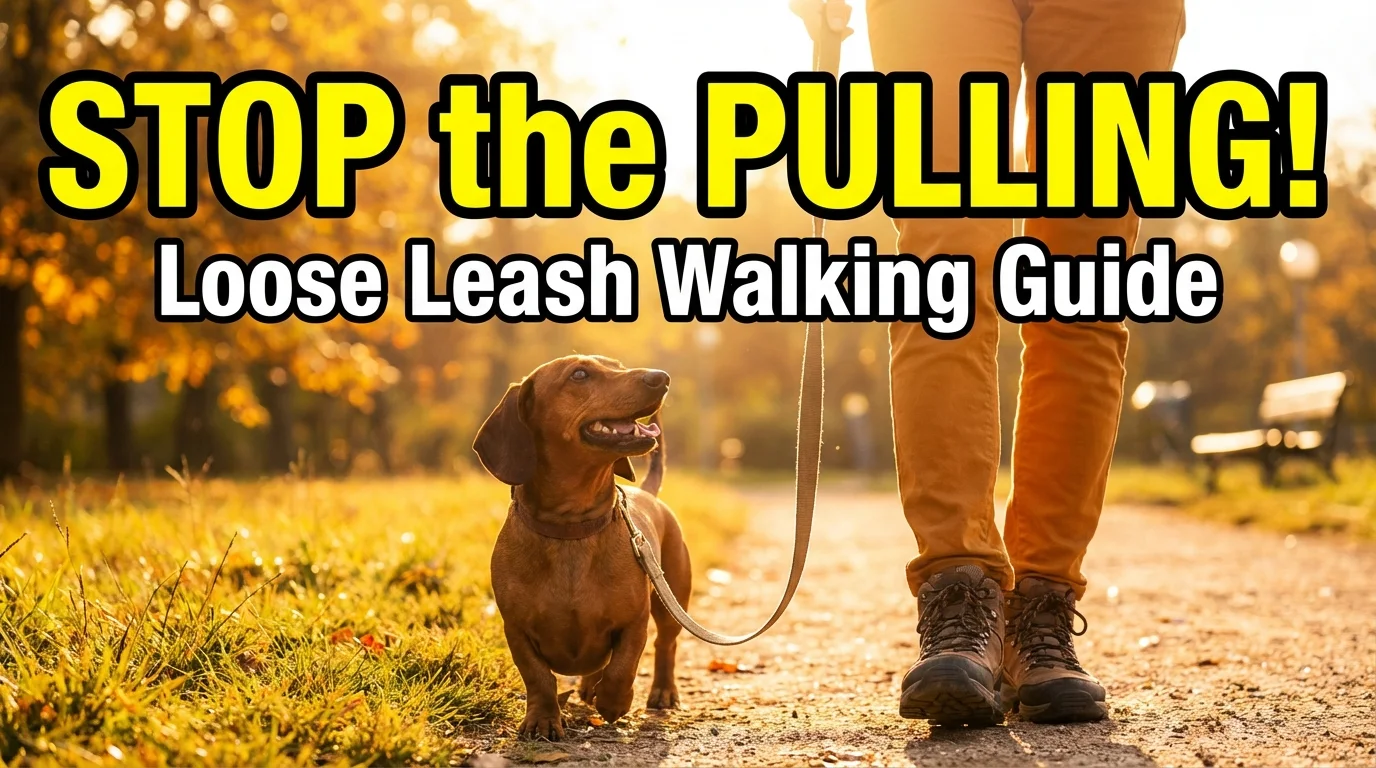
A dachshund pulling on the leash is more than an inconvenience. Constant forward pulling with a collar around the neck places strain on the cervical spine and trachea, and for a breed already predisposed to intervertebral disc disease, this is a genuine health risk. Using a well-fitted harness is strongly recommended for all dachshunds, and teaching loose-leash walking should be a training priority.
The Stop-and-Wait Method
- Begin walking. The moment the leash becomes taut, stop completely.
- Stand still and wait. Do not pull back, jerk the leash, or say anything. Simply become a tree.
- When your dachshund looks back at you, turns toward you, or otherwise creates slack in the leash, immediately mark the behavior (click or "yes!") and reward.
- Resume walking. Repeat every time the leash tightens.
This method requires extraordinary patience, particularly in the first few sessions when a walk around the block may take 30 minutes. But the consistency of the message, that pulling stops all forward progress, is crystal clear even to a stubborn dachshund.
Rewarding the Correct Position
In addition to stopping when the dog pulls, actively reward your dachshund for walking in the correct position beside you. Click and treat every few steps when the leash is loose and your dog is near your side. Over time, being near your side becomes the default because that is where good things happen.
Scent Walk Compromise
Acknowledge your dachshund's powerful nose by building "sniff breaks" into walks. Walk with the "let's go" cue when you want the dog at your side, and periodically release with a "go sniff" cue that allows the dog to explore at the end of the leash. This compromise satisfies the dog's scenting needs while maintaining structure during the walking portions.
Frequently Asked Questions
At what age should I start training my dachshund?
Training begins the moment your dachshund enters your home. Even at 8 weeks old, puppies are capable of learning their name, basic house rules, and simple cues like "sit." Keep training sessions extremely short for young puppies (one to three minutes), use gentle handling, and focus on making every interaction positive. Formal obedience classes typically accept puppies after their first round of vaccinations, around 10 to 12 weeks old. While early training is ideal, it is never too late to train an adult dachshund. Older dogs may take longer to unlearn established habits, but they are absolutely capable of learning new ones with the right approach.
Will my dachshund become treat-dependent if I use food rewards?
No, not if you manage the reward schedule correctly. Food is used heavily during the initial learning phase to clearly communicate what behavior you want. Once the dog reliably performs the behavior on cue, you transition to a variable reinforcement schedule: sometimes the dog gets a treat, sometimes verbal praise, sometimes a scratch behind the ear, sometimes nothing extra at all. Variable reinforcement actually makes the behavior more resistant to extinction (more durable) than consistent reinforcement because the dog maintains an expectation that the next response might produce a reward.
My dachshund ignores me when we are outside. What should I do?
Outdoor environments are exponentially more stimulating than your living room. If your dachshund listens indoors but ignores you outdoors, you have a distraction problem, not a defiance problem. Go back to basics and retrain each command in progressively more distracting environments. Start in your yard, then a quiet park, then a busier area. Use higher-value treats outdoors than you use indoors. Practice recall and attention exercises on a long line so the dog cannot self-reward by running off. Building a strong "watch me" (eye contact) command gives you a tool to redirect your dachshund's attention from distractions back to you.
How do I handle my dachshund's destructive behavior when left alone?
Destructive behavior during your absence can stem from boredom, insufficient exercise, or separation anxiety. For boredom and energy issues, ensure your dachshund receives adequate physical exercise and mental stimulation before you leave. Puzzle feeders, stuffed and frozen Kongs, and snuffle mats provide enrichment during your absence. Crate training provides a safe confinement option for dogs that are destructive when unsupervised. However, if the destruction is accompanied by signs of panic (salivation, attempts to escape the crate or room, self-injury, continuous vocalization), the cause is likely separation anxiety, which requires professional behavioral intervention and possibly medication.
Conclusion
Training a dachshund is not about overpowering a stubborn dog. It is about outsmarting a clever one. When you understand that your dachshund's independence is not defiance but heritage, that their stubbornness is actually persistence, and that their selective hearing is actually prioritization, you can stop fighting against the breed's nature and start working with it.
The most successful dachshund owners are those who master the art of making compliance more rewarding than noncompliance. When sitting on cue produces a delicious treat, when walking politely earns continued forward progress, when quiet behavior brings attention and barking brings nothing, even the most strong-willed dachshund will choose cooperation.
Be patient. Be consistent. Be generous with rewards and stingy with punishment. Keep training sessions short, upbeat, and always ending on a high note. And above all, appreciate that the very qualities that make your dachshund challenging to train, their intelligence, their boldness, their unwavering persistence, are the same qualities that make them one of the most captivating and endearing breeds in the world.